


Why Does My Tree Look Uneven or Off-Balance in Calgary?
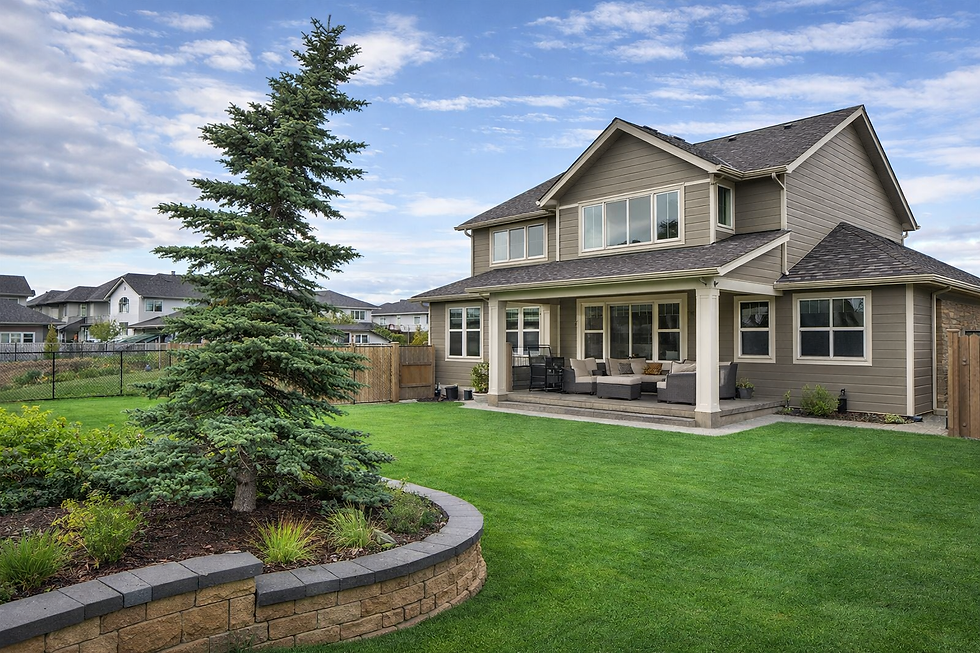
If your tree looks lopsided, leans to one side, or has a strange shape, you’re not alone. Many homeowners in Calgary notice their trees growing unevenly and aren’t sure whether it’s a problem or just natural variation. The truth is, trees adapt to their environment, and visual imbalances can result from a mix of natural responses, human interference, or structural issues.
At Evergreen LTD, we help Calgary homeowners understand what’s normal and when an uneven tree might need expert attention. Here's what you should know.
1. Trees Grow Toward Light
The most common reason a tree looks off-balance is phototropism, the natural tendency of trees to grow toward available light.
Common scenarios:
A tree growing near a house or fence may stretch in one direction to reach sunlight.
Nearby taller trees can create uneven shade, forcing smaller ones to grow lopsided.
Large evergreens often create dense shade that causes surrounding trees to bend and twist in response.
This directional growth can lead to long-term asymmetry if not managed early.
Seeing your tree grow sideways toward the sun? Book a consultation with Evergreen LTD to assess whether corrective pruning is needed.
2. Wind and Weather Shape Tree Growth
In Calgary, wind is a major influence on tree form. Trees regularly exposed to strong winds may:
Develop branches mostly on the leeward side (downwind)
Grow shorter or thicker limbs as a protective response
Lean slightly away from prevailing winds
This is known as a flagging effect, and while it can look odd, it may not always be a structural issue. That said, if a tree starts leaning more over time or has uneven root support, it could become a hazard.
Concerned your leaning tree might fall? Evergreen LTD offers certified tree risk assessments across Calgary.
3. Improper Pruning Causes Long-Term Imbalance
One of the most avoidable causes of uneven tree growth is poor or uneven pruning.
Examples include:
Cutting only one side of the tree to clear power lines
Topping or removing central leaders
Lion’s tailing, which removes inner branches and leaves tufts at the tips
These actions disrupt the natural balance of the tree and can lead to:
Excessive regrowth (water sprouts)
Weak branch structure
Long-term shape distortion
Proper pruning focuses on structure, not just looks, especially for young trees.
Need a pruning correction plan? Evergreen LTD uses ISA standards to guide tree shape safely and effectively over time.
4. Root and Soil Problems Can Distort Growth
Healthy roots are critical to a tree’s form and balance. If one side of the root system is compromised, the canopy above will often reflect it.
Root-related causes of imbalance include:
Girdling roots that restrict nutrients on one side
Compacted or dry soil limiting root expansion
Damage from construction, trenching, or paving near trees
In these cases, branches on the affected side may be smaller, sparser, or fail to grow at all.
Think your tree has root issues? We can perform a root collar inspection and soil analysis to pinpoint the problem.
5. Some Trees Are Naturally Asymmetric
Not every “uneven” tree is unhealthy. Some species naturally grow with irregular crowns or sprawling limbs.
Examples:
Eastern redcedar often grows irregularly, especially in windy areas.
Live oaks and other broad-canopy species can appear off-balance depending on your viewing angle.
Trees with multiple leaders (when the central stem doesn’t dominate) may grow in unusual shapes.
Understanding what’s normal for your species is essential to knowing whether intervention is needed.
Not sure if your tree’s form is natural or problematic? Our certified arborists can identify species-specific traits and advise on care.
6. Hidden Structural Issues Can Cause Leaning or Imbalance
Sometimes what looks like uneven growth is actually a sign of deeper problems. Structural issues to watch for:
Internal decay or cavities
Co-dominant stems with included bark (a common failure point)
Heaving soil or exposed roots at the base
Signs of recent shifting or increased lean
These can compromise stability and lead to tree failure if not addressed early.
See a visible lean or signs of decay? Call Evergreen LTD right away for a tree safety inspection.
What Can You Do About It?
Most trees that appear uneven can be managed with proper care. Our approach includes:
Corrective pruning to redistribute weight and encourage balanced growth
Cabling or bracing for structural support in mature trees
Soil improvement to address compaction or drainage issues
Young tree training to guide long-term structure and symmetry
The earlier you act, the better the outcome. Waiting too long may limit your options or require more invasive solutions.
Want a healthy, well-shaped tree for years to come? Partner with Evergreen LTD for long-term tree care tailored to Calgary conditions.
Final Thoughts: Not All Uneven Trees Are Unsafe
An off-balance tree is not always a dangerous tree, but it does warrant a closer look. Whether your tree is growing toward light, recovering from poor pruning, or developing asymmetrically due to root problems, understanding the cause is the first step toward proper care.
At Evergreen LTD, we provide Calgary homeowners with expert diagnosis and long-term solutions for trees of every shape and size.
Comments