


Can Calgary’s Clay Soil Cause Nutrient Problems in Trees? Here’s What to Do Before Winter


Your tree may be getting water. The soil may even contain the nutrients it needs.
But that does not always mean the tree can actually use them.
Calgary yards commonly contain clay-heavy, compacted and alkaline soils. These conditions can make it harder for tree roots to access important micronutrients such as iron, manganese and zinc. Over time, that stress can show up as yellowing leaves, weak growth, thinning canopies and declining tree health.
Going into a Calgary winter already stressed can make it harder for a tree to cope with cold, wind, snow and other environmental pressures.
That is why fall tree care should start below the surface.
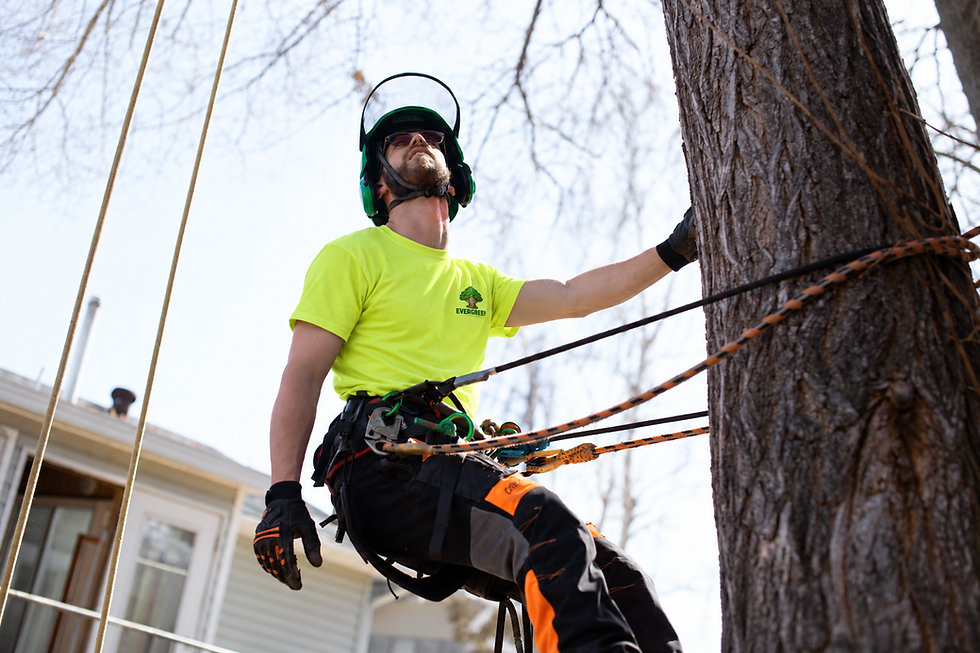
Evergreen LTD’s ISA Certified Arborists can assess your tree and root-zone conditions, identify signs of nutrient stress and determine whether a micronutrient-rich fertilizer should be part of the treatment plan.
How Does Calgary’s Clay Soil Affect Tree Nutrition?
Clay soil has some advantages. It can hold water and nutrients very well.
The problem is what happens when that soil becomes compacted.
Clay particles are extremely small, and tightly packed soil leaves less room for air and water to move through the root zone. Tree roots need oxygen to function properly. When root growth and respiration are restricted, nutrient uptake can also suffer.
Soil pH creates another challenge.
Calgary soils are often alkaline. As soil pH increases, certain micronutrients become less available to plant roots, including iron, manganese and zinc.
The nutrient may already be present in the soil, but the tree can still struggle to absorb enough of it.
This is one reason adding random fertilizer to a struggling tree does not always solve the problem.
What Does Nutrient Stress Look Like in a Tree?
One of the most recognizable signs is yellow foliage.
Iron chlorosis, for example, often causes leaves to turn yellow while the veins remain greener.
You may also notice:
Pale or yellow leaves
Smaller leaves than normal
Weak or limited new growth
A thinning canopy
Early leaf drop
Twig dieback
A tree that seems to be declining despite regular watering
However, these symptoms can also be caused by drought, damaged roots, drainage problems, de-icing salts, insects or disease.
That is why the first step should be determining what is actually causing the decline.
Seeing yellow leaves or weak growth? Contact Evergreen LTD to have an ISA Certified Arborist assess your tree and determine whether soil conditions or nutrient availability may be contributing to the problem.
Why Does This Matter Before a Calgary Winter?
A healthy tree uses its growing season to produce carbohydrates and store energy that support its roots, defence systems and future growth.
When a tree spends the season under prolonged nutrient or root stress, its overall vitality can decline.
That matters when winter arrives.
Calgary trees already have to cope with cold temperatures, Chinooks, strong winds, snow loads and rapid weather changes. Nutrient problems do not automatically mean a tree will fail in a storm, but a chronically stressed tree may be less resilient when additional environmental stress is added.
Declining trees can also become increasingly expensive to manage if problems progress.
Dead branches may require pruning. Severe decline may eventually require removal. Large mature trees can also be valuable parts of a property’s shade, appearance and landscape.
Addressing tree health early gives you more opportunity to protect that investment.
Will Fertilizer Fix the Problem?
Sometimes fertilization is an important part of the solution, but the type of fertilizer and the reason for applying it matter.
If a tree is lacking access to micronutrients, a properly formulated fertilizer containing nutrients such as iron, manganese and zinc may help support tree health.
But fertilizer cannot repair severe soil compaction, damaged roots, poor drainage or improper planting.
That is why Evergreen LTD looks at the condition of the tree and its growing environment before recommending treatment.
Our ISA Certified Arborists can evaluate visible symptoms, soil conditions and the root zone to determine whether fertilization, improved watering, mulch, soil care or another treatment makes sense.
Before applying fertilizer on your own, book an assessment with Evergreen LTD and find out what your tree actually needs.
Give Your Trees Better Support Before Winter
You cannot change Calgary’s soil or winter weather, but you can improve the conditions your trees are growing in.
Healthy roots, appropriate moisture and access to essential nutrients all contribute to stronger tree growth and long-term resilience.
If your trees are showing yellow leaves, weak growth, thinning canopies or other signs of stress, fall is a good time to find out why.
Evergreen LTD’s ISA Certified Arborists can assess your trees, identify possible nutrient and soil-related concerns and recommend the appropriate care for your property.
Where micronutrient support is needed, Evergreen LTD can provide professional tree fertilization designed around the condition of your trees and the challenges of Calgary growing conditions.

Comments